
Logic puzzles are a popular class of puzzle that challenges the mind and requires logical thinking. The grid style is the most common variety referred to as a “logic puzzle”, but logic puzzles come in various forms and there are benefits to be enjoyed by people of all ages!
The purpose of logic puzzles is to provide a mental workout and improve cognitive skills in the form of a fun, leisurely activity that can be relaxing and satisfying to complete.
Logic puzzles require the player to use reasoning and deduction to solve a problem. They are designed to test the player’s ability to think logically and critically. They are solved using a variety of techniques, including process of elimination, pattern recognition, and logical inference.
The potential benefits of solving logic puzzles are numerous, including improving memory, enhancing problem-solving skills, and reducing stress.
Types of Logic Puzzles
There are many different types of logic puzzles, each with its own unique set of rules and challenges. Some of the most popular variations include:

- Grid puzzles: These puzzles require the solver to fill in a grid with information based on a set of clues – see our collection of logic grid puzzles if you would like to play one now!
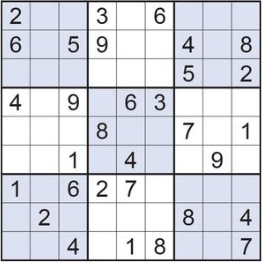
- Sudoku: Sudoku is an increasingly popular puzzle that could also be considered a type of grid puzzle. The objective of Sudoku is to fill a 9×9 grid with numbers so that each row, column, and 3×3 sub-grid contains all the digits from 1 to 9. The puzzle begins with some numbers already filled in, and the player must use logic and deduction to fill in the rest of the grid. There are also many variations to this standard format.
All cars are vehicles.
All hatchbacks are cars.
Therefore, all hatchbacks are vehicles.
- Syllogisms: Syllogisms usually comprise of 3 statements, and the puzzle player uses logic to deduce whether the third statement is true or false.
I know a word. It has six letters, if you remove one letter, you’ll be left with 12. What is it?
- Brain teasers: Brain teasers are puzzles that require the solver to use logic and critical thinking to arrive at the correct answer. They often involve math or visual puzzles.
The answer to the brain teaser can be found at the end of this article.
The Purpose of Logic Puzzles
Logic puzzles are often used as a form of entertainment, but they can also serve a greater purpose – both in school children who are developing critical thinking and reasoning skills, and adults who like to improve these skills or give their brains a regular workout to ward off cognitive decline.
In this section, we will explore the benefits of solving logic puzzles and how they can help in problem-solving.
Benefits of Solving Logic Puzzles
One of the most significant benefits of solving logic puzzles is that they can help improve cognitive skills. Studies have shown that regularly engaging in activities that require critical thinking and problem-solving can help improve memory, concentration, and overall cognitive function.
Children’s development: By solving puzzles, children learn to think logically, analyze information, and make connections between different pieces of information. This helps them to develop their reasoning skills, which are important for academic success.
Preventing cognitive decline: According to a large study of over 50’s who do puzzles such as crosswords and sudokus, as reported by ScienceDaily, “researchers calculate that people who engage in word puzzles have brain function equivalent to ten years younger than their age, on tests assessing grammatical reasoning and eight years younger than their age on tests measuring short term memory.”
Another benefit of solving logic puzzles is that it can help reduce stress and anxiety. When individuals engage in activities that require their full attention, they can become more focused and present in the moment. This can help reduce stress and anxiety levels by providing a mental break from daily stressors.
Finally, solving logic puzzles can be a fun and engaging way to pass the time. As an added bonus – while some are brief and straight to the point, other logic problems have a creative and engaging back story that can be an entertaining read, immersing the reader in the world created by the writer. If the story is based on real-world facts, it can also be an opportunity to learn about a new topic.
How Logic Puzzles Help in Problem-Solving
When solving a logic puzzle, individuals must use a combination of deductive reasoning, critical thinking, and trial and error to arrive at the correct solution. These skills can be applied to real-life situations, as individuals learn to approach problems in a systematic and logical way.
Logic puzzles help in problem-solving by teaching people how to break down complex problems into smaller, more manageable parts. By analyzing the clues and information provided in a logic puzzle, individuals learn to identify patterns and relationships between different pieces of information. This helps them to develop their critical thinking skills, which are essential for solving problems in all areas of life.
Additionally, solving logic puzzles can help individuals develop their lateral thinking skills. Lateral thinking is the ability to approach problems from a different perspective and to think creatively to arrive at a solution. This type of thinking can be valuable in a variety of situations, as it allows people to come up with innovative solutions to problems.
The more logic puzzles you solve, the better you will get at them. Practice regularly to improve your skills!
Browse our collection of logic grid puzzles or first learn how to solve a logic grid puzzle.
Answer to the brain teaser: Dozens.